400 to 590 kg (880 to 1,300 lb.) conservation status:
Manatee Teeth Facts. New teeth come in at the back of the jaw and move forward horizontally about a centimeter a month. Manatees have a very interesting set of teeth. Manatees have only six neck vertebrae. Throughout a manatee's life, the molars are constantly replaced — an adaption to their diet of abrasive vegetation. Manatees, like their elephant relatives, continuously replace their teeth. While they manatee does have teeth, they don't use them for eating. Their diet causes teeth erosion because of all the sand caught in the plants. Manatees have no biting teeth, only grinding teeth. Manatees have only six neck. The front molars eventually fall out and are replaced by the teeth behind them. Manatees' only teeth are called marching molars. A manatee's teeth (all molars) are constantly being replaced. All their teeth are molars, perfect for grinding up the underwater vegetation that makes up their diet. Manatees' only teeth are called marching molars. Throughout a manatee's life, the molars are constantly replaced — an adaption to their diet of abrasive vegetation.
Manatee Teeth Facts . Facts About Manatees - Manatee Facts And Information
AWESOME HIGH QUALITY MANATEE TOOTH FLORIDA FOSSILS TEETH .... Their diet causes teeth erosion because of all the sand caught in the plants. Manatees have only six neck. Manatees have a very interesting set of teeth. Manatees have no biting teeth, only grinding teeth. Manatees, like their elephant relatives, continuously replace their teeth. A manatee's teeth (all molars) are constantly being replaced. New teeth come in at the back of the jaw and move forward horizontally about a centimeter a month. Manatees' only teeth are called marching molars. Manatees have only six neck vertebrae. All their teeth are molars, perfect for grinding up the underwater vegetation that makes up their diet. Throughout a manatee's life, the molars are constantly replaced — an adaption to their diet of abrasive vegetation. The front molars eventually fall out and are replaced by the teeth behind them. While they manatee does have teeth, they don't use them for eating. Manatees' only teeth are called marching molars. Throughout a manatee's life, the molars are constantly replaced — an adaption to their diet of abrasive vegetation.
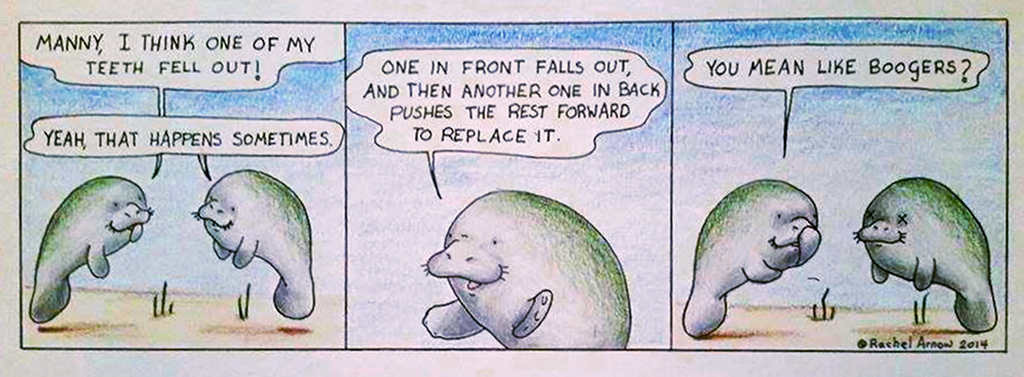
Manatee Teeth Gallery from manvsmanatee.com
Manatee teeth are continuously replaced from back to front as they grind down throughout their lifetime. A manatee's teeth (all molars) are constantly being replaced. They are big eaters—the ocean's largest herbivore measuring almost 14 feet long and weigh as much as 3,000 pounds. Because manatee are docile herbivores, grazing on various aquatic plants, they have only molars for teeth. That is they don't have different types such as incisors or canine teeth like humans and other types of animals do. They live in the water but since manatees are mammals they can not breathe underwater. All three species are rated vulnerable other interesting manatee facts:
New teeth come in at the back of the jaw and move forward horizontally about a centimeter a month.
Manatees have only six neck. Manatees have four rows of teeth. The teeth have also evolved in response to dietary demands. All three species are rated vulnerable other interesting manatee facts: That is they don't have different types such as incisors or canine teeth like humans and other types of animals do. Manatee are part of the order sirenia. If you are just getting started, you may want to begin with our manatee facts page. Manatees have a unique breathing system. Manatees have no biting teeth, only grinding teeth. Manatees have only six neck. They are big eaters—the ocean's largest herbivore measuring almost 14 feet long and weigh as much as 3,000 pounds. How to swim with manatees; Luckily their friendly nature means all those teeth are never a threat to humans. Tooth replacement continues throughout their life. Manatee facts at a glance. To handle such a diet, manatees are hindgut digesters (like horses) and have intestines as long as 30 metres (100 feet). Their food has tiny granules of sand in it, which gradually wears down their teeth. Manatees have the smallest brains in relation to. Manatees spend six to eight hours a day eating sea grass and other aquatic vegetation. They use their teeth to munch on seagrass and other plant life. In comparison to other mammals' teeth, manatee teeth are very unique. Unlike humans, manatees generate new teeth all their lives. Mothers may try to intervene, but they are slow and have little offense. The teeth have also evolved in response to dietary demands. Manatees are herbivores plant eating animals; Manatees' only teeth are called marching molars. Manatee teeth are unique in that they are replaced horizontally, as opposed to vertically as in most other mammals. Manatees usually mull around at about 5 miles an hour , but can motor up to 15 miles per hour in short bursts. The front molars eventually fall out and are replaced by the teeth behind them. They have been known to reach 13 ft long and weigh up to 3500 lbs; As the teeth wear down, new molars grow in the back of the mouth and gradually move forward.
Manatee Teeth Facts : Manatees' Only Teeth Are Called Marching Molars.
Manatee Teeth Facts , Manatees In The Amazon River And The Manatee Rescue Center ...